Is a Cirrus a Good First Airplane for Flight Training?
When someone is choosing where to begin flight training, one common question is whether it makes sense to start in a Cirrus. The answer is not a simple yes or no. A Cirrus can be a very good first airplane for instruction, but it depends on the student’s goals, budget, learning style, and the quality of the training program.
Traditionally, many pilots begin their training in aircraft such as a Cessna 172 or a low wing Piper. These airplanes are often called as the "legacy" aircrafts. They are simple, proven, forgiving, and cost-effective. They are excellent platforms for learning the basic stick-and-rudder skills that every pilot needs. A Cirrus, on the other hand, introduces the student to a more modern flying environment from day one. It has advanced avionics, considered TAA [Technically Advanced Airplane 61.129(j)], a faster pace, more automation, and a safety system that includes the Cirrus Airframe Parachute System, commonly known as CAPS.
That combination can be a major advantage, but only if it is handled correctly.
The biggest advantage: training in the airplane you actually want to fly
One of the best arguments for learning in a Cirrus is simple: if your long-term goal is to own, rent, or regularly fly a Cirrus, training in one from the beginning can make sense.
Instead of learning in one airplane and then transitioning later, you are building habits in the same type of cockpit and operating environment you plan to use. You become familiar with the avionics, checklists, power settings, sight picture, procedures, and decision-making style that are specific to the Cirrus.
This can be especially useful for students who are not just trying to get a license, but who want to become capable real-world pilots. The Cirrus is commonly used for personal transportation, business trips, family travel, and IFR cross-country flying. Training in that environment can help a student understand early that flying is not just about controlling the airplane. It is also about planning, managing workload, using automation properly, monitoring weather, and making conservative decisions.
The Cirrus teaches modern cockpit management early
A Cirrus is a technically advanced aircraft. That means the student must learn more than just pitch, power, trim, and rudder coordination. They also need to learn how to use a glass cockpit (either Avidyne or Garmin suite), GPS navigation, autopilot functions, engine monitoring, traffic information, terrain awareness, and system alerts.
For some students, this is a huge benefit. It teaches them from the beginning how modern aviation works. They learn to scan both outside and inside the aircraft. They learn how to manage information without becoming distracted by it.
However, this is also where the Cirrus can become challenging. A new student can easily become overloaded if they are trying to learn basic aircraft control while also managing a sophisticated avionics system. That is why Cirrus training must be structured carefully. A good instructor will not let the airplane’s technology distract from the fundamentals. The student still needs to learn how to look outside, maintain airspeed, fly coordinated, land consistently, and make good decisions without depending too heavily on automation. Always AVIATE, NAVIGATE and COMMUNICATE.
Safety is a strength, but it must be understood correctly
One of the most well-known features of Cirrus aircraft is CAPS, the parachute system designed to bring it down the aircraft safely in an emergency. This is an important safety feature and one of the reasons many people are attracted to Cirrus aircraft.
But it is important to be very clear: the parachute is not a substitute for training, judgment, or discipline.
In a good Cirrus training program, CAPS is not treated like a marketing feature. It is taught as part of emergency decision-making. Students should understand when it may be appropriate to use, the minimum altitude, and why hesitation in a true emergency can be dangerous. The system is valuable, but only when the pilot is trained to use it correctly.
The Cirrus is faster, and that changes the training environment
Compared to many traditional training aircraft, a Cirrus generally moves faster and requires the student to stay ahead of the airplane. This matters.
In a slower trainer, a student has more time to think, correct mistakes, and prepare for the next phase of flight. In a Cirrus, things can happen more quickly. Pattern work, approach planning, radio calls, checklist usage, and energy management all require more situation awareness.
This does not mean a beginner cannot learn in a Cirrus. It means the training must be intentional. The instructor must make sure the student is not just “riding along” with the airplane. The student has to actively understand what is happening, why it is happening, and what comes next.
A Cirrus can build excellent habits if taught correctly. It forces the student to plan ahead. But if the training is rushed, it can also allow a student to hide behind technology (often using the autopilot) instead of truly mastering the basics.
Cost is one of the biggest considerations
The Cirrus is usually more expensive to operate than a basic trainer. Rental rates, insurance requirements, maintenance costs, and instructor qualifications can all make Cirrus training more expensive.
For some students, the extra cost is worth it because they specifically want Cirrus experience. For others, it may make more sense to complete the Private Pilot License in a simpler, less expensive aircraft and then transition into the Cirrus afterward.
There is no shame in either path. The best choice is the one that fits the student’s mission.
If the goal is to earn a Private Pilot License as efficiently and affordably as possible, a traditional trainer may be the better starting point. If the goal is to become comfortable in a modern, high-performance-style cockpit from the beginning, then Cirrus training can be a smart investment.
SR20 vs. SR22: which one makes more sense for primary training?
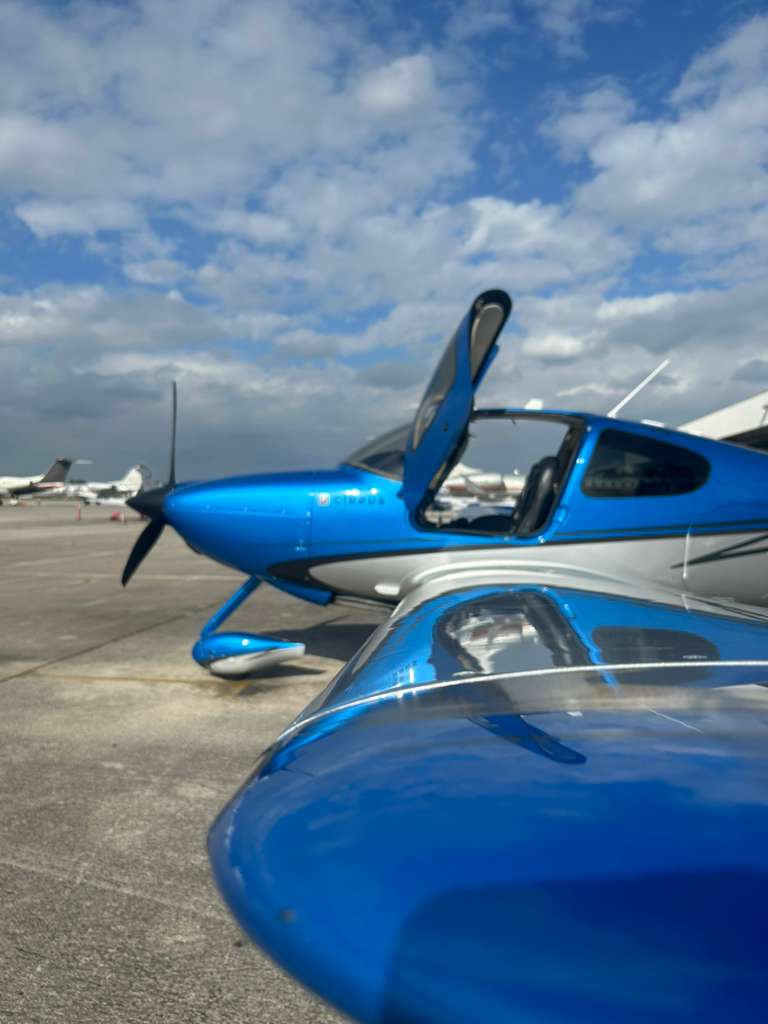
For a first-time student, the Cirrus SR20 is usually the more practical Cirrus training platform. It still provides the modern Cirrus cockpit, avionics environment, CAPS training, and professional operating style, but it is generally more manageable for primary instruction than the higher-performance 300hp or more SR22.
The SR22 is an excellent aircraft, but it brings more performance, more cost, and often more insurance considerations. It may be better suited for pilots who already have the basics established or for students whose specific goal is to own or operate an SR22 with proper training and supervision.
For most new students considering Cirrus training, the SR20 is the more logical starting point.
Who is a good fit for learning in a Cirrus?
A Cirrus can be a good first airplane for a student who is serious, disciplined, and willing to study. The airplane rewards preparation. A student who shows up ready, reviews procedures, studies the avionics, and takes checklist discipline seriously can do very well.
It is also a good fit for someone whose long-term goal is personal or business travel in a modern aircraft. If the student wants to fly cross-country, pursue an instrument rating, and eventually use aviation as a real transportation tool, starting in a Cirrus can create a strong foundation.
On the other hand, a Cirrus may not be the best first airplane for someone who is extremely budget-focused, wants the simplest possible learning environment, or is not ready to put in the extra study time outside the airplane. The airplane itself is capable, but the student must be committed.
The most important factor is not the airplane. It is the training.
The truth is that a student can become a good pilot in many different airplanes. A Cessna, Piper, Diamond, Cirrus, or other training aircraft can all produce excellent pilots when the instruction is strong and the student takes the process seriously.
The airplane matters, but the training matters more.
A good Cirrus training program should focus on fundamentals first. The student should learn aircraft control, traffic pattern discipline, landings, emergency procedures, weather decision-making, radio communication, and situational awareness. The avionics and automation should support that training, not replace it.
The student should also be taught to respect the airplane. A Cirrus is comfortable, capable, and technologically advanced, but it is still an aircraft that demands proper judgment. Good pilots are not created by equipment alone. They are created by repetition, discipline, humility, and quality instruction.
Final answer: yes, but only for the right student
So, is a Cirrus a good first airplane for instruction?
Yes, it can be. For the right student, with the right instructor and the right training program, a Cirrus can be an excellent first airplane. It introduces modern avionics, real-world procedures, advanced safety systems, and a professional approach to flying from the beginning.
But it is not automatically the best option for everyone. A student should consider the cost, the faster pace, the avionics workload, and their own willingness to study and prepare. For some students, starting in a simpler aircraft and transitioning later may be the smarter path. For others, beginning in a Cirrus may be exactly the right decision.
The best airplane for flight training is the one that matches the student’s goals while still allowing them to build strong fundamentals. If the student is committed, properly instructed, and trained with discipline, the Cirrus can be much more than a beautiful aircraft. It can be a serious and effective training platform.
Ready to Start Your Flight Training in a Cirrus?
Think the Cirrus is the right aircraft for you to begin your flight training? GoFly Academy offers FAA-approved Part 141 Private Pilot training from zero flight experience in the Cirrus SR20 G3.
If your goal is to become a confident, well-trained private pilot in a Cirrus, GoFly Academy can help you take the first step.